
The AI market shifted hard this week. Anthropic dropped Claude Opus 4.8 with a literal effort dial. Elon Musk threw $60 billion at Cursor. Apple registered a domain that leaks their entire iOS 27 strategy. I map out exactly what happened and show you how to code a free web app from scratch.
Table of Contents
- ●Anthropic drops Claude Opus 4.8 and hires Andrej Karpathy
- ●The $60 billion AI coding war
- ●Apple WWDC 2026 leaks for iOS 27
- ●Everyday AI updates you need to know
- ●ChatGPT auto-fills forms and tracks finances
- ●Spotify and Amazon rethink audio
- ●Robotics and mathematics
- ●Build a free AI app with Open Code
- ●Pros of Open Code
- ●Cons of Open Code
- ●Frequently asked questions
- ●Is Claude Opus 4.8 available for free users?
- ●How does Cursor Composer 2.5 compare to GitHub Copilot?
- ●Can I run Open Code on a weak laptop?
Key Takeaways from This Week:
- Anthropic shipped Claude Opus 4.8 with auto-correction and variable reasoning dials.
- SpaceX bought Cursor for $60 billion to train a raw coding model on Colossus 2.
- Apple registered gen.ai.apple.com to prep for its iOS 27 release.
- Open Code launched as a free, local competitor to Claude Code.
Anthropic drops Claude Opus 4.8 and hires Andrej Karpathy
Anthropic just released Anthropic Claude Opus 4.8. Models usually lie to you. They claim a task is finished when the code is half-baked. Opus 4.8 flags its own uncertainties directly. It drops a warning in your terminal before executing risky file changes. You get 4 times fewer syntax errors.
Opus 4.8 ships with a 2 million token context window. You can upload an entire 500-page codebase. The model reads it in 12 seconds. It also ships with a fast mode. You get 2.5 times the speed for a third of the original cost.
But the real feature is the `/remote-control` command. You trigger a massive refactoring job on your work laptop. You type the command. Claude takes over the keyboard and mouse. You watch it work from your phone while grabbing coffee. It executes terminal scripts, clicks through your browser, and tests the local host automatically.
Anthropic also bolted on the `/effort` command. You manually dial in the compute power. Set it to 1 for quick bash scripts. Crank it to 10 for enterprise database migrations. Max effort tells Claude to spin up 100 parallel sub-agents. These agents argue with each other to verify the code.
claude --effort 10 "Refactor the payment gateway to use Stripe webhooks. Test all edge cases."If you want a deeper look at Anthropic’s recent trajectory, check out our guide on the Anthropic Claude 4 Opus release.
And Andrej Karpathy just joined the pre-training team. The former OpenAI founder and Tesla AI director left retirement for one specific job. He uses Claude to write training scripts for the next Claude. Anthropic stopped buying raw GPUs blindly. They now use their own AI models to write the curriculum for the next generation.

The $60 billion AI coding war
The coding agent space is heavily contested right now. Cursor launched Composer 2.5. It matches Claude Opus 4.7 on the SWE-bench test. It costs just 50 cents per 1 million input tokens. That makes it the cheapest frontier-level coding agent on the market.
Cursor fed it 25 times more synthetic data than the previous version. They scraped 50 million public repositories. They filtered out the bad code. They forced the engine to solve 10 million simulated pull requests. It now understands 10,000-line codebases instantly.
Elon Musk wanted this tech for SpaceX. He bought Cursor for $60 billion in cash and stock. SpaceX engineers need an AI that understands orbital mechanics and legacy C++ code. Musk is training a brand new coding model on the Colossus 2 supercomputer.
Colossus 2 runs on 100,000 H100 GPUs. They will feed Cursor’s architecture directly into xAI‘s infrastructure. Musk expects the new model to write full satellite flight software by December.
Meanwhile, Alibaba dropped Qwen 3.7 Max. This is a massive proprietary model from Alibaba. It handles standalone software engineering natively. Alibaba engineers gave it a blank AI chip and walked away for 35 hours.
The model executed 1,050 tool calls. It compiled a C++ computing kernel from scratch. That kernel ran 10 times faster than the chip manufacturer’s official driver. Qwen 3.7 Max costs 6 times less than Claude Opus. You can rent it via API today.
| Coding Agent | Key Feature | Price (per 1M Input Tokens) |
|---|---|---|
| Cursor Composer 2.5 | Trained on 25x synthetic tasks | $0.50 |
| Alibaba Qwen 3.7 Max | Multi-file standalone engineering | Extremely low (6x cheaper than Opus) |
| Claude Opus 4.8 | Variable reasoning & sub-agents | Premium ($15/month base) |
Apple WWDC 2026 leaks for iOS 27
Apple registered a new subdomain exactly 14 days before WWDC 2026. They bought gen.ai.apple.com. The site is completely blank. But it confirms their iOS 27 strategy. Apple will run heavy tasks on their Private Cloud Compute servers. They keep your data off public grids entirely.
Siri gets a complete rebuild. Apple licensed Google’s Gemini models for the backend. Siri will read your local SQLite databases. It will scan your iMessage history and Apple Mail inbox natively. You ask it to find the exact PDF receipt from a flight 3 years ago. It pulls the file in 2 seconds.
Siri also gains camera awareness. You point your iPhone 17 at a physical restaurant menu. You ask Siri what the cheapest vegan option is. The on-device vision model reads the text and speaks the answer instantly. Apple killed the tap-and-hold button. You now swipe down from the dynamic island to trigger a search.
Everyday AI updates you need to know
Consumer tools received massive upgrades this week. Here is a rapid breakdown of the new features hitting your devices.
ChatGPT auto-fills forms and tracks finances
OpenAI pushed a voice update that kills manual data entry. You snap a photo of your IRS 1040 tax form. You speak to ChatGPT and tell it your W-2 numbers. The model parses the blank boxes. It hands you a filled PDF in 45 seconds.
OpenAI also launched a finance dashboard for US users. It hooks into 12,000 banks via Plaid. You ask ChatGPT to find forgotten subscriptions. It reads your credit card statements and lists exactly what you pay for. It cancels the bad subscriptions for you with a single prompt.
Spotify and Amazon rethink audio
Spotify signed a legal deal with Universal Music Group. You can hit a button and turn a Taylor Swift track into a lo-fi study beat directly in the app. Spotify handles the royalties on the backend. The original artist gets 50 percent of the streaming revenue.
Spotify also launched personalized daily podcasts. You give it a 2-sentence prompt. It builds a 30-minute conversational show. It synthesizes two host voices that debate your chosen topic.
Amazon copied this feature with Alexa Podcast. You tell your Echo speaker you want to learn about Roman history. Alexa scrapes 200 news sites and Wikipedia. It generates a 15-minute studio-quality audio show on demand. The latency is under 10 seconds.
Robotics and mathematics
Boston Dynamics posted a terrifying video of their Boston Dynamics Atlas robot. The robot squatted to lift a 100-pound refrigerator. It rotated its electric torso 180 degrees. It placed the fridge on a steel table.
Boston Dynamics never explicitly programmed this movement. The robot figured it out inside a physics simulation. It mapped the center of gravity dynamically and adjusted its joints in real-time.
An OpenAI math model just solved a 80-year-old geometry problem. Erdos proposed the puzzle in 1946. The AI ignored standard grid math. It plotted a custom dot pattern and generated a 125-page mathematical proof. The model ran 50,000 simulations per minute to verify the logic.
Build a free AI app with Open Code
Claude Code costs $15 a month. Most APIs enforce hard rate limits. Open Code fixes this problem. This free open-source desktop client connects to 75 different AI models. You select Xiaomi’s Mimo model inside the settings. You build full-stack web apps without paying a single cent.
Open Code reads your local files directly. It pushes commits straight to GitHub. This is how the autonomous AI agents ecosystem actually works in practice. I will show you how to build a React productivity app in 5 minutes.
- Download the app: Go to code.ai and download the installer. Install it like a normal desktop application. You do not touch the terminal yet.
- Configure the model: Open the preferences menu. Select “Mimo-72B” from the drop-down list. Set the reasoning effort slider to “High”. Read our guide on how to use OpenClaude for free for alternative setup methods.
- Use Plan Mode: Paste your prompt into the chat bar. Open Code asks you 3 follow-up questions about your tech stack. It writes a 4-page technical architecture document mapping out your React components.
I want to build a React website for time management. I need a Pomodoro timer, a task list, and a SQLite database to save user history. Write the architecture plan.- Switch to Build Mode: Flip the toggle in the top right corner. Type your execution command. Open Code splits your prompt into 3 parallel tasks. Agent 1 writes the Node.js backend. Agent 2 builds the React frontend. Agent 3 spins up the database.
Run sub-agents in parallel to execute the architecture document. Create all files and run npm install.- Launch the app: Wait 3 minutes. The agents finish the codebase. You type `npm run dev` in your terminal. Your app goes live on localhost:3000.
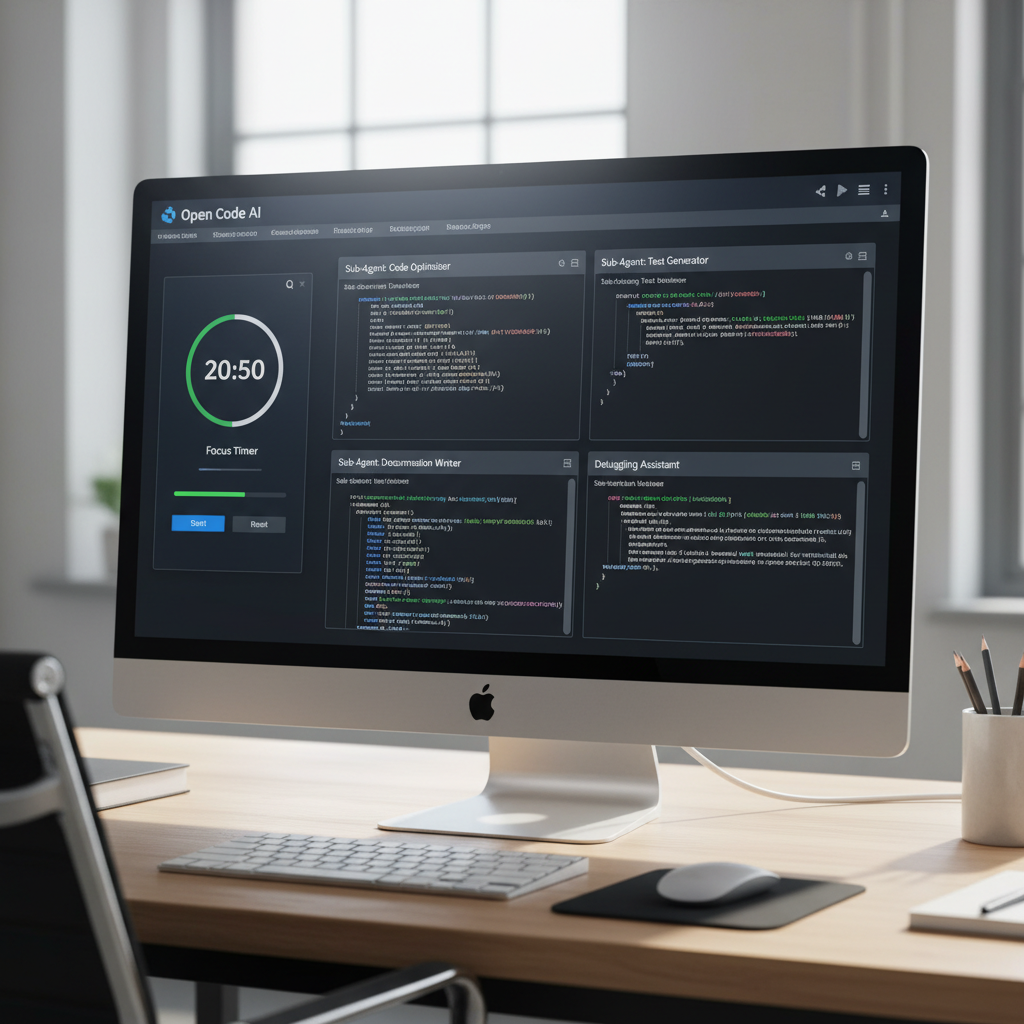
The resulting app is called Focus Flow. It has a working 25-minute Pomodoro timer. It saves your task history to the local database. It draws a bar chart of your productive hours. You built this without writing a single line of JavaScript.
You need a real server to put this app on the internet. You rent a Virtual Private Server. You can easily deploy Claude Code web apps or Open Code apps using Ubuntu. I highly recommend using Hostinger for these raw Node.js projects. It costs $4 a month. You get full root access. You install Nginx, map your domain name, and generate a free SSL certificate in 10 minutes.
Pros of Open Code
- 100% free when using Mimo.
- Runs parallel sub-agents automatically.
- Connects to 75 different LLMs.
Cons of Open Code
- Requires desktop installation.
- UI is slightly intimidating for beginners.
- Free models hallucinate more than paid Opus.
Frequently asked questions
Is Claude Opus 4.8 available for free users?
No. Anthropic restricts Claude Opus 4.8 to the Pro tier and API developers. Free users get Sonnet or Haiku models. You pay $15 a month for the heavy reasoning features.
How does Cursor Composer 2.5 compare to GitHub Copilot?
Cursor Composer 2.5 acts as a fully autonomous agent. It edits 50 files simultaneously. Copilot functions primarily as a localized autocomplete tool. Cursor trained Composer on 25 times more synthetic data, making it vastly superior at long context tasks.
Can I run Open Code on a weak laptop?
Yes. Open Code pushes the heavy processing to remote APIs. Your laptop only runs the lightweight desktop client and stores the text files. An 8GB RAM machine handles it easily.
The barrier to creating software just dropped to zero. Anthropic fixed model hallucinations. Open-source communities built free routing tools. Stop reading about these API updates. Start typing commands into your terminal.
Host Your First AI Web App Today

Written by Mangaleswaran
Mangaleswaran is the founder of AIZnap (aiznap.com) and a dedicated AI content creator. With a background in blogging and technology, he has a deep passion for making artificial intelligence accessible to everyone. He specializes in breaking down complex AI tools, tutorials, and updates into simple, practical guides that anyone can follow. Whether you are a complete beginner or someone looking to use AI to build websites, apps, or grow your online presence — Mangaleswaran's content is designed to help you take action with confidence.
View all posts