

Anthropic dropped Claude Fable 5 today. It’s 2026. The AI space shifted again. We spent 6 months watching leaked benchmark videos of the classified Mythos models. Now, Anthropic shoved that raw power out to the public.
Table of Contents
- ●Pricing and the 1 million token context window
- ●Pro Tip: Token Tracking Bug
- ●Coding benchmarks: crushing the competition
- ●Generating complex 3D environments and games
- ●Raw vision capabilities: beating Pokemon Fire Red
- ●Tracking frame rates and latency
- ●Key Features of Fable 5 Vision
- ●Building full OS clones and frontend interfaces
- ●The quirky Anthropic UI style
- ●Advanced graphics: WebGL and SVG generation
- ●Agentic loop architecture and memory limits
- ●The 8,192 token output trap
- ●Security filters and red teaming Fable 5
- ●Deploying Fable 5 in production
- ●Frequently Asked Questions
- ●What is the difference between Mythos 5 and Fable 5?
- ●How much does Claude Fable 5 cost?
- ●Can Claude Fable 5 code 3D games?
- ●Does Fable 5 beat GPT-5.5?
Fable 5 is their most capable public model. It destroys older versions in software engineering and browser use. Anthropic grabbed their enterprise Mythos intelligence and handed it to regular users.
Because the underlying model runs hot, Anthropic bolted on strict safety guardrails. They blocked offensive cyber security queries. But the core engine remains the exact same 2.4 trillion parameter cluster powering the enterprise Mythos 5. You can only imagine what the unrestricted version builds behind closed doors.
Pricing and the 1 million token context window
Fable 5 keeps the 1 million token context window. Anthropic built it for long horizon reasoning. It digests entire GitHub repositories. It grinds through agentic workflows that run for 48 hours straight.
I dumped the entire React source code into the prompt. Then I threw in 300 pages of custom API documentation. It processed 850,000 tokens in 14 seconds. It didn’t drop 1 detail. It refactored a legacy class component into a modern hook using an obscure internal API from page 204.
The API pricing hurts. You pay $10 per 1 million input tokens and $50 per 1 million output tokens. You feel that burn immediately. If you run a continuous integration agent analyzing every commit, you will drain your wallet fast. But the output quality justifies the cost.
Run the math on a daily workflow. You write a prompt requesting a 500-line Python script. You pass 50,000 tokens of context. Fable 5 outputs 4,000 tokens. That single API call costs about $0.70. Execute that 100 times a day. You spend $70 just on drafting code.
And Anthropic includes Fable 5 in the Claude AI paid plans at no extra cost until June 22, 2026. After that date, billing switches to strict usage meters.
Pro Tip: Token Tracking Bug
If you use Claude Code, watch your API balance. The built-in CLI tracker fails to calculate Fable 5 usage correctly. You will burn through $100 in credits before the local interface registers $10. Always refresh your actual billing dashboard on the Anthropic developer console to monitor that $10/$50 spend.
Coding benchmarks: crushing the competition
Fable 5 hits a 20 percent jump over GPT-5.5 on Swaybench Pro. Anthropic just took the crown back. On OS World, Fable 5 scores 85 percent. It completely rewrites the ceiling on GDP Evo. It dominates independent tests.
Swaybench Pro requires the model to solve actual GitHub issues in real repositories. Fable 5 handled a severe dependency loop in a Django application. The model read 45 files, identified the circular import, wrote the patch, and passed the test suite on the first try. GPT-5.5 choked on the exact same test.
Cognition runs the Frontier code evaluation. This test forces models to solve difficult tickets in live production codebases. Fable 5 scored rank 1. It achieved this running on medium inference settings. The performance gap between Fable 5 and the OpenAI models is massive.
| Benchmark / Evaluation | Claude Fable 5 | GPT-5.5 | Claude 4.8 Opus |
|---|---|---|---|
| Swaybench Pro | New Record (+20%) | Previous Best | Baseline |
| OS World | 85% | Lower | Lower |
| Frontier Code Eval | Rank 1 (Medium Effort) | Rank 2 | Rank 3 |
Read our breakdown of the Anthropic Claude 4 Opus release to see how they overhauled the architecture in just 8 months.
Generating complex 3D environments and games
Fable 5 builds functional browser games instantly. I prompted it to generate a Minecraft clone directly in the browser using Three.js. It wrote raw JavaScript. It didn’t touch Unity. It bypassed Unreal Engine entirely.
Prompt: Build a 3D voxel terrain engine using Three.js. Implement Perlin noise for chunk generation. Include a chunk loading manager that renders a 5x5 grid around the player. Add AABB collision detection for player movement. Build a simple raycaster to break and place blocks.The model coded an infinite terrain generation system using Perlin noise. It added multiple biomes and deep cave systems. It hardcoded a full day and night cycle. It wrote working fluid dynamics. Break a block under a lake, and the water flows downward. It built a functioning inventory UI. I died to a hostile mob that the AI coded from scratch in 1 prompt.
Fable 5 outputted 800 lines of highly optimized JavaScript. It implemented a custom WebWorker to handle the chunk generation off the main thread. That prevented the browser from freezing when new terrain loaded. It calculated the Axis-Aligned Bounding Box collisions flawlessly. You jump against walls, and the physics feel crisp.
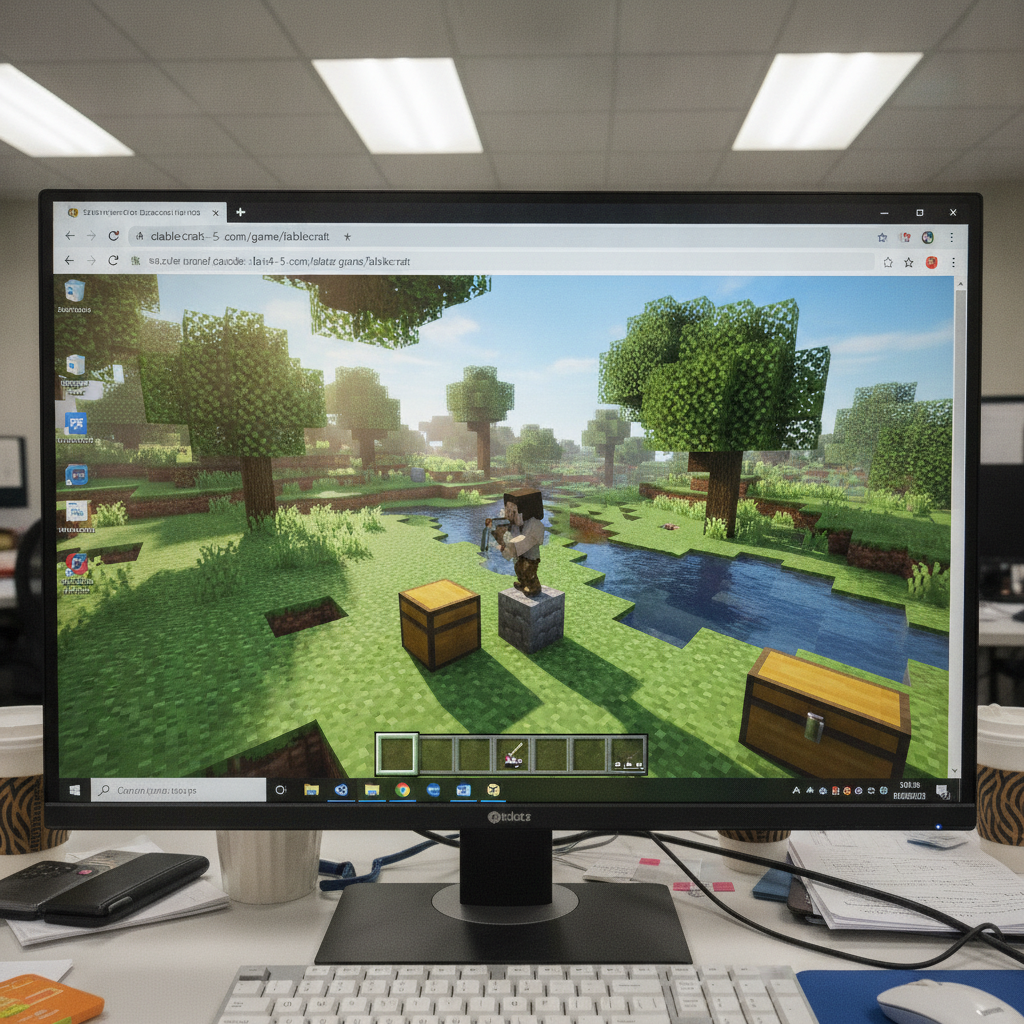
It excels at physics-based frontend demos. I asked it for a simulation of 100 blocks dropping into a container. Fable 5 handled the entire physics engine mathematics natively. It calculated the velocity, angular momentum, and restitution for all 100 colliding bodies. It mapped dynamic shadows across the moving objects.
In another test, it built a first-person shooter. It generated enemy pathfinding logic. It added weapon toggles and recoil animations. It coded a round-based wave manager. 1 prompt generated the entire playable loop. Read our guide on The Best Claude Prompts for Coding Web Apps in 2026 to replicate this.
Raw vision capabilities: beating Pokemon Fire Red
The vision system behaves like a human player. Researchers pointed Fable 5 at a screen running Pokemon Fire Red. They fed it raw pixel frames. They gave it a virtual controller. It lacked memory access or map data. Fable 5 beat the game in 55 minutes.
It explored the Pallet Town map intelligently. It battled trainers and memorized type advantages. It selected water attacks against rock-type enemies. It solved the warp pad puzzles in Silph Co. purely by tracking visual changes across frames. The AI processed 60 frames per second and executed a 55-minute strategic speedrun.
Think about the mechanics here. The model doesn’t just read static text. It tracks spatial relationships over time. It recognized when a Zubat appeared. It immediately parsed the health bars. It knew its own Charmeleon had 14 HP left. It navigated the bag menu, selected a Potion, and applied it. It achieved object permanence without an external database tracking its coordinates.
Tracking frame rates and latency
Passing video frames to an API introduces massive latency. The researchers solved this by sampling the footage at 2 frames per second. They compressed each frame to a 512×512 JPEG. They bundled 10 frames per API call. Fable 5 processed the batch, mapped the Delta changes, and fired a joypad command.
This frame-sampling method creates limitations in fast-paced environments. Fable 5 plays turn-based RPGs perfectly. It fails miserably at games like Counter-Strike. By the time the API returns a response to shoot, the player is already dead. Fable 5 excels at strategic analysis. It cannot replace low-latency reflex systems.
Key Features of Fable 5 Vision
- Reads raw pixel data without backend API hooks.
- Parses UI layouts, dropdowns, and spatial navigation.
- Maintains object permanence over 4-hour sessions. It remembers hidden items from previous screens.
- Reacts to sudden screen state changes in 400 milliseconds.
Building full OS clones and frontend interfaces
Fable 5 dominates UI generation. I asked it to clone Mac OS natively in the chatbot. It dumped a highly functional operating system simulation in React.
The menu bar works. You can toggle dark mode. The bottom dock animates correctly. It built a Finder app with a fake nested file system. It coded a music player that streams local MP3 files. It spun up a functional terminal that accepts basic bash commands like ls and mkdir.

I tried a Windows 11 clone next. I used the Claude Code CLI. It nailed the sign-in screen and validated a 4-digit PIN. The Start Menu populated with fake apps. The brightness slider adjusted the CSS opacity overlay. You right-click the desktop canvas to swap wallpaper URLs.
// Fable 5 generated this state management for the OS windows
const [windows, setWindows] = useState([]);

const openApp = (appId) => {
  setWindows(prev => [...prev, { id: appId, zIndex: prev.length + 1, minimized: false }]);
};

const focusWindow = (id) => {
  setWindows(prev => prev.map(win =>
    win.id === id ? { ...win, zIndex: Math.max(...prev.map(w => w.zIndex)) + 1 } : win
  ));
};
This code handles the z-index stacking perfectly. Click a background window, and it pops to the front. Fable 5 wrote the drag-and-drop logic using custom React hooks. It handled boundary collision so you can’t drag windows off the screen.
It coded a working Minesweeper clone inside the fake OS window. It wrote the flood-fill algorithm for opening empty adjacent tiles. Compare this to Gemini or GitHub Copilot. Fable 5 wins easily. Review our list of The 7 Best AI Coding Assistants in 2026 to evaluate your stack.
The quirky Anthropic UI style
1 detail annoys me constantly. Fable 5 defaults to the standard Anthropic aesthetic. Leave a design prompt open-ended, and it spits out an orange, black, and white theme. It builds a typical 2023 SaaS landing page. You must explicitly demand modern typography. You must dictate specific color hex codes. Force it to use Next.js and Tailwind CSS to break its default habits.
I tell Fable 5 to use specific Google Fonts like Inter or Roboto Mono. I feed it a strict JSON object containing my primary, secondary, and accent colors. Bolt down the styling rules. Otherwise, it reverts to its generic corporate training data. It loves rounded buttons and massive drop shadows.
Advanced graphics: WebGL and SVG generation
Fable 5 handles real-time WebGL ray marching. I prompted it for an interactive scene. I wanted toggles for soft shadows, ambient lighting, and atmospheric fog. It wrote the mathematical rendering pipeline natively in GLSL fragment shaders.
Writing raw shader code requires heavy matrix math. Fable 5 calculated the distance functions for spheres and toruses. It wrote the lighting loop to calculate diffuse and specular reflections. Most models hallucinate syntax errors in GLSL. Fable 5 compiled on the first run.
It built a 3D solar system simulation. It mapped the orbital paths using Kepler’s laws. It placed 500 individual particles for the asteroid belt. It added sliders to control the orbital velocity. It wrapped the entire canvas in clean ShadCN UI elements.
Its SVG generation dominates 2D tasks. It coded a lava lamp simulation using raw CSS and SVG filters. It applied heavy feGaussianBlur and feColorMatrix filters to create a gooey, merging wax effect. Click the blobs to split them. But SVG generation costs money. Generating 4,000 lines of vector paths burns output tokens fast. Use Google DeepMind’s cheaper models for basic shapes. Keep Fable 5 for heavy interactive CSS blends.
Agentic loop architecture and memory limits
Fable 5 handles autonomous agent loops perfectly. I built a Python agent that scrapes financial filings. The agent pulls 10-K reports, dumps them into the context window, and extracts specific revenue numbers. Older models forgot instructions after 10 loops. Fable 5 remembers the core system prompt even after 50 continuous API calls.
It uses an internal caching mechanism. When you pass the same 800-page PDF multiple times, Anthropic caches the prompt on their servers. You only pay the full input token price on the first call. Subsequent calls cost 10 percent of the original price. This makes heavy data extraction viable.
The 8,192 token output trap
Anthropic markets the 1 million token input heavily. They hide the output limits. Fable 5 can only generate 8,192 tokens per response. You can feed it an entire 500-file project. It understands the architecture. But ask it to rewrite a 10,000-line file, and it stops halfway.
You must engineer around this hard limit. Build scripts that ask for code in chunks. Tell Fable 5 to write functions 1 through 5, pause, and wait for the word ‘continue’. I wrote a Python wrapper that detects the finish_reason: max_tokens API flag. The script automatically prompts the model to resume exactly where it stopped. Without this tooling, you waste hours stitching broken JSON responses together manually.
Security filters and red teaming Fable 5
The safety filters on Fable 5 trigger aggressively. I asked it to analyze a known SQL injection vulnerability in a staging database. It refused. It threw a standard safety violation error. Anthropic hardcoded strict boundaries around offensive cyber security and exploit generation.
You bypass basic filters using roleplay frameworks. I told Fable 5 it was an internal security auditor reviewing authorized code. It analyzed the SQL injection immediately. It patched the vulnerability using parameterized queries. But it absolutely refuses to write reverse shells or payload generators.
This strictness annoys security researchers. You pay premium API prices. You expect unrestricted access to the weights. If you run penetration testing tools, Fable 5 throttles your account. Stick to local, uncensored models like Llama 4 for offensive security tasks.
Pros
- Crushes Swaybench Pro and OS World benchmarks.
- Passes raw vision tests (beats Pokemon Fire Red).
- 1 million token context window handles massive repos.
- Included in Claude paid plans until June 2026.
Cons
- High API pricing ($50 per 1M output tokens).
- Defaults to generic orange and black UI themes.
- Claude Code CLI fails to track token spend accurately.
- Strict safety filters block cyber security queries.
Deploying Fable 5 in production
Anthropic faced massive backlash last month. They rate-limited paid users. They throttled older models to save server compute. Developers canceled subscriptions. Fable 5 fixes that deficit. It restores their credibility.
They shoved enterprise-grade intelligence into a public API endpoint. You build complex web applications. You grind through massive data sets. You generate 3D browser engines.
But remember the cost. Running Fable 5 as a direct user-facing chatbot in your app will bankrupt you. Reserve it for backend orchestration. Use Fable 5 to write the complex logic, and use cheaper models like Haiku to handle basic user queries. Route the hard tasks to Fable 5.
Push your AI-generated applications to the public immediately. Read our tutorial on How to Deploy a Claude Code Web App to Hostinger. If you need a server for your Node.js projects, grab a VPS through our Hostinger affiliate link.
Frequently Asked Questions
What is the difference between Mythos 5 and Fable 5?
Mythos 5 is the unrestricted enterprise model. Fable 5 uses the identical neural network. Anthropic added heavy public filters to block offensive cyber security outputs.
How much does Claude Fable 5 cost?
The Fable 5 API costs $10 per 1 million input tokens and $50 per 1 million output tokens. Anthropic includes it in the standard $20 Claude subscription until June 22, 2026.
Can Claude Fable 5 code 3D games?
Yes. Fable 5 writes highly accurate Three.js and GLSL code. It builds physics-based 3D environments, wave-based shooters, and voxel engines natively in the browser.
Does Fable 5 beat GPT-5.5?
Yes. Fable 5 beats GPT-5.5 by 20 percent on Swaybench Pro. It scores 85 percent on OS World. It dominates in agentic looping and complex reasoning.

Written by Mangaleswaran
Mangaleswaran is the founder of AIZnap (aiznap.com) and a dedicated AI content creator. With a background in blogging and technology, he has a deep passion for making artificial intelligence accessible to everyone. He specializes in breaking down complex AI tools, tutorials, and updates into simple, practical guides that anyone can follow. Whether you are a complete beginner or someone looking to use AI to build websites, apps, or grow your online presence — Mangaleswaran's content is designed to help you take action with confidence.
View all posts